Thursday, March 15, 2012

Question: How do we find compound loci?

Answer: Ok so we already know what loci is, now what is a compound loci?
Well a compound locus problem involves two or more locus conditions in one problem. The way to differentiate a compound locus problem from a regular locus problem is by the words "AND" and "AND ALSO."

Example Problem:
A treasure is buried in your backyard.  The picture below shows your backyard which contains a stump, a teepee, and a tree.  The teepee is 8 feet from the stump and 18 feet from the tree.  The treasure is equidistant from the teepee and the tree AND ALSO 6 feet from the stump.  Locate all possible points of the buried treasure. (Figure 1)
Figure 1


Step 1:
Ok first read the problem and determine ONE of the locus conditions.
Step 2:
Solve the first locus solution and plot it.
Step 3:
Re-read the problem and identify the second locus condition.
Step 4:
Solve the second locus solution and plot it.

Ok so now lets see this would look like: (Figure 2)
Figure 2
Explanation of Solutions:
The red line represents the locus which is equidistant from the teepee and the tree (the perpendicular bisector of the segment AKA the first locus condition). The blue circle represents the locus which is 6 feet from the stump (the second locus condition). These two loci intersect in two locations. The treasure could be buried at either "X" location. 

NOW YOU TRY! :D


Two points A and B are 6 units apart.  How many points are there that are equidistant from both A and B and also 5 units from A?

1. 1
2. 2
3. 3
4. 4

Question: How do we find the locus of points?

Answer: So what is a locus? Well a locus is the set of all points that satisfy a given condition.
The plural of locus is loci

Ok now, let me explain how to identify the different types of locus problems.
There are 5 types of locus problems.

LOCUS PROBLEM #1: Finding the locus of one point
Figure 1
Whenever you are trying to find the locus of one point, the loci will be equidistantly away from the point. In figure 1, for example, the locus of points away from point P will be an equal distance away from the point, thus it will produce a circle with the original point (P) in the center.

LOCUS PROBLEM #2: Finding the locus of two points
Figure 2
Whenever you are trying to find the locus of two points, the loci will be a line through the middle of the two points. As illustrated in figure 2, for example, the locus of points away from points P and Q will be the perpendicular bisector of the line segment connecting the two points.

LOCUS PROBLEMS #3: Finding the locus of a line
Figure 3
Whenever you are trying to find the locus of a line, the loci will be two parallel lines on opposite sides of te original line. As illustrated in figure 3, for example, the locus of points of line L will be two lines, opposite sides, equidistant and parallel to the original line.

LOCUS PROBLEM #4: Finding the locus of two lines
Figure 4
Whenever you are trying to find the locus of two lines, the loci will be a line through the middle of the two lines. As illustrated in figure 4, for example, the locus of points of lines L1 and L2 will be another line halfway between both lines, and parallel to each other.

LOCUS PROBLEM #5: Finding the locus of two intersecting lines
Figure 5
Whenever you are trying to find the locus of two intersecting lines, the loci will be two intersecting lines halfway between the two original lines. As illustrated in figure 5, for example, the locus of points of lines L1 and L2 will be two additional lines that bisect the angles formed by the original lines.


NOW YOU TRY! :D

What shape would the locus of points 3 inches away from point A form?
1.A circle
2.A square
3.A triangle 
4.A rhombus 

Saturday, March 3, 2012

Question: What is a mathematical statement?

Answer: A mathematical statement is a statement that can be judged to be true or false.
Ex. John Kennedy was a U.S. President.

Now lets go over negations.
Negations (not) always adds the opposite truth value to a mathematical statement.
Ex. John Kennedy was not a U.S. President.

When dealing with mathematical statements, we will usually look at more than one statement.
And since we will be dealing with multiple we must know what conjunctions are.
Conjunctions connect two statements with words such as and, but, or.

Ex. The President of the U.S. is Barack Obama and the vice president is Joe Biden.
And - both statements must be true for the statement to be true
Ex. I'm going to have pizza or tacos for dinner.
Or - Either statement (or both) can be true for the statement to be true.

Now let's talk about conditionals. The conditional is the most frequently used statement in the construction of an argument or in the study of mathematics (geometric proofs). There are four types of conditionals:
     -Conditional
               -Converse
                         -Inverse
                                   -Contrapositive
     
NOW YOU TRY! :D
Is the following a mathematical statement?

An owl is a fish. Yes or no?

Question: What is logic?

Answer: LOGIC IS THINKING!!!

Logic is simply a tool that we use to determine between true or false.

For example, we all use logic every single day.
Logic is kind of like common sense.

When you come to a busy street and you decide whether to cross or not, then you are using logic.

There is also inductive reasoning.
Inductive reasoning is when you use prior knowledge to predict the future (it might not always be true).

NOW YOU TRY! :D


How have you used logic today?

Sunday, February 26, 2012

Question: How do we use the other definitions of transformations?

Answer: You may ask: Didn't we learn all we had to learn about transformations? o.O
And the answer is, not yet. :(
But don't worry, we are almost there! :D
There are only three more things that we must discuss about transformations, they are:
                               Glide Reflection, Orientation, and Isometry. 

Lets start with glide reflection. What is glide reflection?
Glide reflection is the combination of a reflection in a line and a translation along that line.
Figure 1. This is an example of a glide reflection.
Figure 1 illustrates how the Figure was translated to the right and then reflected over the line.
Figure 2. This is how a glide reflection would be written out.
IMPORTANT: Whenever you solve a glide reflection, order doesn't matter, it is not like compositions of transformations where you have to start with the second transformation. In glide reflection, you can start with any transformation first.

Okay now lets move on into isometry. So what is isometry? 
Isometry, which is also referred to as isometric transformation, is a transformation of the plane that preserves length.  
What does that mean? Well that means that a figure can be moved around on a plane and as long as the length of the sides of the figure are the same, then it is an isometry. Lets look at an example:
Figure 3. The original triangle has gone through various transformations but the length of the sides have not changed so it is an isometry.

Now lets go over Orientation. What is orientation? 
Orientation refers to the arrangement of points, relative to another.
When orientation is preserved it is called a direct isometry. This means that the order of the letters on the diagram go in the same clockwise or counterclockwise on the figure and its image.

Figure 4. A translation is an example of a direct isometry because the order of the letter on the figure and image go in the same counterclockwise direction (orientation preserved).
 An opposite isometry changes the order (clockwise turns into counterclockwise).
Figure 5. Reflection is an example of opposite isometry because the order of the letters went from counterclockwise to clockwise (orientation not preserved).

NOW YOU TRY! :D

A triangle has vertices A(3,2), B(4,1) and C(4,3).  
What are the coordinates of point B under a glide reflection: 
 ?

1) (2,-4)
2) (4,0)
3) (4,-2)
4) (-4,2)

Question: How do we graph dilations?

Answer: So do you remember what a dilation is? If not then let me explain :)
A dilation is a type of transformation that causes an image to stretch or shrink in proportion to its original size. 

Okay now that we reviewed what a dilation is, lets go more in depth about dilations. :D

Whenever you do a dilation there will always be a scale factor.
So what's a scale factor? 
Well, a scale factor is the ratio by which the image stretches or shrinks. 
So how do we know if the figure will shrink or enlarge? o.O
Easy, if the scale factor is greater than one, then the image is enlarged.
          If written out, the scale factor would look like this --> D2
And if the scale factor is greater than zero but less than one, then the image will shrink. 
          If written out, the scale factor would look like this --> D1/4

Ok so now that we know how a dilation looks like, and what a scale factor is. So how do we solve a dilation problem? 
Well, all you have to do is multiply the dimensions of the original image by the scale factor to get the dimensions of the dilated image. 

For example: If we have a Triangle A(1,2) B(2,3) C(3,2) and a scale factor of D2 all we have to do to solve this problem is multiply the coordinate point of the triangle by the scale factor. This means:
2x(1,2)=(2,4)        so the image point A would be (2,4)
2x(2,3)=(4,6)        the image point B would be (4,6)
2x(3,2)=(6,4)        and the image point C would be (6,4)

NOW YOU TRY! :D

Given point A(6,5) and scale factor D3 what would be the image point?

Question: How do we solve composition of transformation problems?

Answer: Ok, first of all, lets go over what a composition of transformation is.
A composition of transformation is when two or more transformations are combined to form a new transformation.
Figure 1. This is how a composition of transformations is written out.

Now that we know what a composition of transformation is, lets go over how to solve it.
In order to solve a composition of transformation problem you must begin by solving the second transformation and then solving the first transformation.
It's a bit confusing so lets look at a picture:

Figure 2.
Ok so now that we have a picture to look at, we have a better idea on how to solve a composition of transformations problem.
As seen in Figure 2, begin with Translation(3,4) and then do reflection over the x-axis.

LETS SEE IF YOU GOT IT :)


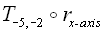
Given Shape A(1,2) B(3,2) C(2,6), solve the following transformation: